
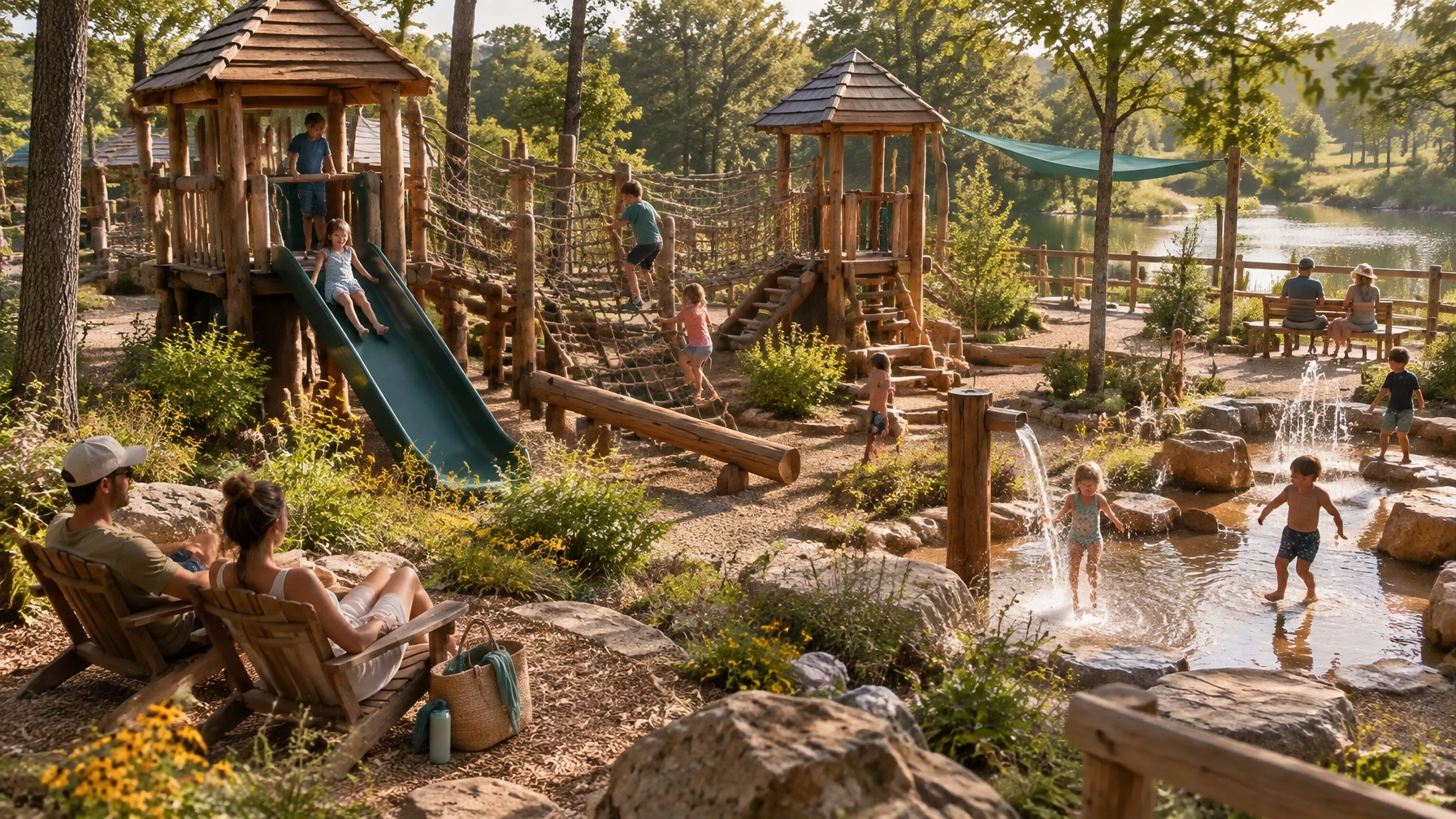
Planning a family road trip with kids who need more than the usual slides and swings? These 13 Southern playgrounds are worth the detour, from Raleigh’s 91-foot mega-swing and giant wooden trolls to an underwater-themed South Carolina playground and Tennessee’s largest inclusive playground of its kind. We’re also breaking down what the equipment actually looks like, which ages each stop fits best, and the real-world details parents care about most, including parking, shade, and restrooms.
To help keep our content free, some links in this post are affiliate links. If you click and buy something, we may receive a small commission (at no extra cost to you). As an Amazon Associate, I earn from qualifying purchases.
If your family is tired of the same playground at the neighborhood park, the South is full of creative places worth building a road trip around. From giant swings and storybook castles to nature-built forts and underwater-themed play spaces, these destinations offer more than a few slides and swings.
This guide focuses on unusual, family-friendly playgrounds across the Southern states we cover. Details were checked for 2026, but hours, splash-pad schedules, and temporary closures can change. Always confirm with the official attraction before leaving home.
1. Gipson Play Plaza and the Mega-Swing : Raleigh, North Carolina

Raleigh’s Gipson Play Plaza at Dorothea Dix Park is one of the biggest playground destinations in the Southeast, covering 18.5 acres. Official Dix Park pages and local coverage describe it as a handcrafted, nature-forward play landscape rather than a bright plastic playground, with custom equipment from Richter Spielgeräte, lots of wood, stone, planted gardens, and long sightlines back toward downtown.
The free play complex is spread across several distinct zones. Slide Valley is the big climbing area parents usually notice first: four multi-story towers connected by swaying and fixed bridges, with ladders, ramps, log scrambles, and slides. It reads more like a timber lookout course than a standard play set. Younger or more cautious kids will usually stick to lower climbs, ramps, and shorter slides, while bigger kids tend to make laps across the bridges and towers. Official Dix Park materials also note a shaded caretaker overlook here, which helps if one adult is watching multiple children.
Watermill Mountain sits at the high point and is one of the clearest themed areas in the plaza. Official park pages describe a custom millhouse inspired by Historic Yates Mill, with pumps, pulleys, spouts, dams, and channels that send water downhill. Instead of one flat splash pad, it functions more like a water-work station built into the landscape. Little kids can stay at the lower edges splashing and redirecting shallow flow, while older kids are more likely to work the pumps and experiment with how the water moves. The associated restroom cabanas and changing spaces are nearby, and local coverage has noted 10 cabanas, including one with a private shower, plus an outdoor shower.
Below it, the Sand Bowl is designed as a looser, dig-and-build area where water from Watermill Mountain feeds down toward sand playhouses and construction-style play. This is a good zone for toddlers with close supervision and for elementary-age kids who like scooping, shaping, and collaborative pretend play more than climbing heights. Dix Park says accessible features and transfer points are built into the sand and tower areas, but families with mobility devices should know the official accessibility page is stronger on route access than on exact play-by-play of every component.
The Sensory Maze is a hedge labyrinth with benches and an ADA-accessible gravel surface. Official descriptions mention mirror illusions, whimsical animal elements, and musical components. In practice, that makes it one of the better places for kids who want to wander, hide-and-seek, or explore at a slower pace. It is also one of the easiest zones for mixed-age siblings because there is no single “correct” way to play it.
At Swing Terrace, the headline feature is the 91-foot-long wooden mega-swing. Official materials confirm several swing styles for different ages and abilities, including accessible options such as nest or basket-style seating. Little kids usually use the more supportive seats with an adult nearby; bigger kids and tweens tend to gravitate to the long communal motion of the main swing line. The whole plaza includes at-grade access routes, accessible restrooms, seating, picnic areas, and the House of Many Porches Market for indoor cooling-off and snacks.
Parking and admission are free. Official guidance points families to multiple lots, including ADA parking, and local opening coverage highlighted Lot A as the largest, plus additional lots and shuttle service on busy weekends. The playground is open from 8 a.m. to 9 p.m., and water features generally begin at 10 a.m. One more 2026 note: Dix Park’s official troll map confirms the park’s Thomas Dambo wooden trolls are now another draw nearby, though they are a separate exploration feature rather than part of the play equipment. For current parking, shuttle, and access details, check the official Gipson Play Plaza guide, Swing Terrace details, and Dix Park event calendar.
2. Miracle on the Mountain Play Outside Park : Coalmont, Tennessee
This inclusive destination in Grundy County is one of the biggest new playground projects in Tennessee, with local coverage in 2026 describing a 26,000-square-foot playground beside a roughly 7,000-square-foot splash pad. Reporting from the Chattanooga Times Free Press and other local outlets confirms the broad outline well: it is fully accessibility-focused, built with padded surfacing and shade, and designed so children of different abilities can play together rather than in separate corners.
What is firmly documented is the equipment families are most likely to ask about first: a We-Go-Swing that allows a child to remain in a wheelchair while swinging, a We-Go-Round wheelchair-friendly merry-go-round, an inclusive zip line with a transfer seat, waterproof splash-pad wheelchairs, and restrooms with motorized adult-sized changing tables. Reports also describe a private or climate-controlled caregiver restroom area near the splash pad.
The overall design is repeatedly described as heritage-themed and tied to Grundy County’s communities and landmarks. Reputable local coverage says the layout references county communities and attractions on an outlined county map, with themes connected to local trails, the Caverns music venue, and Gruetli-Laager history. What I could not verify from an official park feature list is the exact appearance, color palette, or a reliable area-by-area map of the structures, so it is better not to overstate the visuals beyond that documented heritage theme.
For parents planning by age: the accessible swing, merry-go-round, and splash features make this a strong pick for toddlers and younger children who need support and easy entry. The zip line and larger open movement spaces are more likely to appeal to bigger kids. Because most detailed 2026 reporting has centered on accessibility and opening progress rather than a full visitor guide, some specifics such as exact shaded seating counts, picnic layout, and parking arrangement are still better treated as subject to on-site confirmation.
Admission is free. The most consistent 2026 reporting says the park operates daily from about 10 a.m. to dusk, weather permitting, at the junction of TN-56 and TN-108 in Coalmont. For an up-to-date visit, confirm conditions and hours through recent local coverage from the Times Free Press before making a special trip.
3. Harvesting Inclusive Play at Jack Benson Heritage Park : Chattanooga, Tennessee
Chattanooga’s Harvesting Inclusive Play at Jack Benson Heritage Park was created for what organizers call “shoulder-to-shoulder play,” and the official and local descriptions make clear that inclusivity—not a flashy single centerpiece—is the point of the design. The farm theme is confirmed, but the published sources are much more specific about layout and access than about decorative details like exact colors.
The playground is approximately 15,000–17,000 square feet and split into two age-based sections: a 2–5 area and a 5–12 area. Local coverage says the younger section is about 6,000 square feet and the older section about 11,000 square feet. Both are tied together with double-wide ramps, accessible routes, specialized handrails, and poured-in-place rubber surfacing, so children using mobility devices can reach elevated play instead of being limited to ground-level panels.
For what kids will actually do there, the reporting consistently mentions sensory panels, cooperative games, and accessible musical instruments. That suggests the farm theme is less about one giant barn facade and more about a multisensory, universally designed play structure where siblings can move side by side. Toddlers and preschoolers will be best in the smaller zone, where lower climbs and easier transitions make more sense. Older children are more likely to use the taller ramps, busier structures, and social features built for 5–12.
Around the playground, the park itself adds the grown-up comforts families care about on longer visits: shade structures, seating, picnic areas, and green space are all noted in 2026 coverage. Heritage Park also has a new pervious parking lot with improved ADA parking and site connections. The articles place the playground near the Don Eaves Heritage House Arts and Civic Center and a dog park, so the setting feels more like a larger community park than a standalone roadside stop.
One accuracy note: I found reliable reporting on the inclusive design and age zones, but not an official public zone-by-zone equipment list naming each farm element, so it is best not to invent barns, silos, tractors, or animals unless you confirm them on-site. The playground is located at 1428 Jenkins Road in East Brainerd. See the latest opening and facility information from Hamilton County and Chattanooga-area coverage.
4. Wildwood Playscape : Enterprise South Nature Park, Chattanooga
If your children prefer logs, climbing, and discovery to bright plastic equipment, Wildwood Playscape at Enterprise South Nature Park is the most natural-feeling stop on this list. The official Hamilton County page and related local coverage confirm the basics—new in 2026, nature-inspired, and built to fit the landscape—but they do not publish a detailed official component-by-component guide.
What is safe to say is that the playscape was designed to blend into Enterprise South rather than stand apart from it. Families should expect a setting built from natural materials, with discovery-style play, room to roam, and hands-on features rather than a color-coded age pod system. Earlier county descriptions referenced sensory boards, games, and activity features, and the grand-opening coverage emphasized imaginative, outdoor play.
Because the official materials are still light on exact descriptions, I would set expectations this way: younger kids will likely use the easier-to-reach climbing elements, tactile features, and open-ended pretend spaces, while bigger kids will get more out of balancing, scrambling, and weaving their own adventure through the site and the surrounding trails. Since it sits inside the much larger nature park, many families will naturally pair it with a short hike or picnic rather than treat it as a one-hour playground stop.
For comfort features, Enterprise South itself has the amenities families usually need: the official county amenities pages list multiple parking lots, picnic areas/tables, water fountains, and several restrooms, including ADA restrooms in the park. What I could not verify from an official Wildwood-specific page is which of those restrooms is closest to the playscape, how much built shade sits directly over the play area versus tree shade, or whether the footprint is exactly three acres, so I would not promise those details too specifically.
The park is at 190 Still Hollow Loop and generally operates from 7 a.m. to 8 p.m. Check the official Wildwood Playscape page for current conditions.
5. Debra’s Playground and Splash Creek : Goose Creek, South Carolina

At Central Creek Park, Debra’s Playground is one of the clearest themed parks in this guide. The city’s official pages describe it as an all-abilities playground with an underwater adventure look and a matching water-play area next door. It covers 26,145 square feet and is built with separate spaces for ages 2–5 and 6–12.
The official equipment list confirms several named pieces: the We Go Round accessible merry-go-round, the Sway Fun Glider, and a ZipKrooz zip line, along with adaptive swings, musical play, and shaded structures. While the city pages do not publish a full color-by-color design sheet, the ocean theme and park photos show the space leaning into aquatic shapes and sea-creature styling rather than a generic primary-color playground.
For little kids, the 2–5 area is the better fit for lower climbs, easier transfers, and close-to-the-ground exploration. Bigger kids are more likely to head for the larger climbing structures, zip activity, and more challenging elevated pieces in the 6–12 section. Because it is an all-abilities park, families should also expect smooth paths and a layout meant to keep siblings together instead of splitting them up by mobility level.
Next door, the 2,600-square-foot Splash Creek continues the ocean concept with more than 10 barrier-free water features. The city specifically names Mr. Claw the crab, Belle Creature the jellyfish, and Big Kahuna Wave among the interactive features. Official and city materials also note that it is designed for wheelchairs, walkers, strollers, and toddlers, so this is not just a sprayground for older kids to sprint through. Younger children will mostly enjoy activating gentler sprays and low features; bigger kids will spend more time running feature to feature and working the interactive elements.
The rest of Central Creek Park matters too if you are making a half-day of it. Official information lists a walking trail, field and stage, food truck court, pavilion space, and substantial parking—including 202 parking spaces, 31 ADA spaces, and 16 van-accessible spaces. The city also notes shade throughout the site and park capacity for 600+ people. The playground is open from dawn to dusk. Splash Creek has seasonal hours, including weekend play and designated toddler and homeschool times. Admission is free. Visit the City of Goose Creek’s Central Creek Park page before visiting.
6. Nature Playscape at Conestee Preserve : Greenville, South Carolina

Conestee’s Nature Playscape is designed around open-ended play rather than manufactured plastic equipment, and both the preserve and Greenville-area coverage are unusually specific about what that means on the ground. The site is fully fenced and sits near the Lake Entrance by the baseball fields, with preserve scenery all around: woods, wetlands, trails, and the broader wildlife-rich preserve beyond.
Many of the structures were built from repurposed lumber, including wood from storm-felled trees and black locust, so the whole place has a handmade, earthy look—bridges, benches, walkways, railings, arches, and carved details all feel like part of the forest. Local coverage also mentions a carved storyteller’s chair or “throne,” which adds to the storybook-in-the-woods feeling without making it feel artificial.
The named zones families ask about are all real and documented. Beaver Lodge is a climbing-focused structure and one of the strongest imaginative anchors in the site. Explorer’s Overlook and Heron’s Nest read more like elevated lookout or treehouse-style spaces. Curiosity Creek is the manmade stream feature; the preserve notes the water is UV-filtered but not for drinking. There is also a rock scramble, downed trees for balancing and climbing, and lots of loose-parts play built around forts, mud, sticks, and nature-building.
For little ones, the preserve has a separate Knee-High Nook for toddlers, and local coverage says there is a dedicated area for ages 3 and under. For older children—roughly 5–12 is the preserve’s main target—the appeal is building, nest-making, damming water, climbing, and inventing games. This is the kind of place where preschoolers linger at the edge of the creek and in the toddler nook, while bigger kids disappear happily into fort-building or repeated trips across logs and bridges.
There are picnic tables on site, and Conestee’s party page notes a covered picnic area in the playscape, though the preserve also indicated some shelter work was still being completed into 2026. Restroom-wise, the official playscape page says there is a portable toilet at the playscape and additional bathrooms nearby at the adjacent baseball complex. The upper portions are wheelchair accessible, but the preserve is clear that the lower natural terrain is not fully wheelchair navigable, which is helpful to know ahead of time.
It is open Tuesday through Sunday and closed Mondays. Admission is free, with a suggested $3 donation. The Lake Entrance is at 840 Mauldin Road. Families can also look for special programs and birthday-party options such as Forest Forts through the official Nature Playscape page.
7. Storyland : New Orleans City Park, Louisiana
Storyland has been bringing nursery rhymes to life in New Orleans City Park since the 1950s, and it still feels different from a standard playground because the play happens inside the story scenery. Official City Park pages describe 18 larger-than-life storybook sculptures and play settings drawn from Mother Goose, Grimm tales, and folktales.
The look is theatrical rather than naturalistic: kids move from one oversized set piece to another under the live oaks. Official pages specifically call out Captain Hook’s Pirate Ship, Pinocchio’s Whale, Jack & Jill’s Hill, the Storyland Castle, and the Little Red Schoolhouse. In 2026, local coverage also confirmed the return of the Dragon Slide, rebuilt in a safer, shorter form while keeping the spirit of the classic version.
For what children actually do there: preschoolers and early elementary kids usually get the most from Storyland because they can climb into the whale, board the pirate ship, go up Jack & Jill’s hill, and treat each sculpture as a mini destination. Bigger kids may enjoy the setting too, especially if they like imaginative play and the novelty of the sculptures, but it is not a thrill-play stop on the level of the biggest climbing parks in this guide.
The Little Red Schoolhouse is one of the best practical details for families in the heat. The official venue page says it is air-conditioned and set up with a teacher’s desk, two small student desks, a chalkboard, a school bell, and kid-sized picnic tables in the yard outside. Pinocchio’s Whale sits under the shade of a live oak canopy, and the castle is a covered stone structure with ceiling fans and adjacent picnic-table space. So while Storyland is outdoors, it does have several pockets of relief and seating built into the attraction.
Official pages confirm on-site restrooms and food/drink spots within Storyland, though they do not map parking in great detail. Families generally park in the broader City Park/Carousel Gardens area and walk in. The official visitor page currently lists hours as Tuesday through Sunday, 10 a.m. to 4:30 p.m., with last entry at 4 p.m. Admission is $8.50 for visitors 36 inches and taller; younger children and Friends of City Park members enter free. Check Storyland’s official visitor page for seasonal updates and events.
8. Explore Playground and Splash Pad : Hoover, Alabama
Hoover Met Complex’s Explore Playground is a 15,000-square-foot inclusive play space paired with a 7,000-square-foot splash pad, and the official site is refreshingly specific about what families will find. It is split into age areas for 2–5 and 5–12, designed around inclusive play principles, and combines elevated structures with lots of ground-level activity.
The centerpiece is Carly’s Clubhouse, a 17-foot-tall central structure. Around it, official Hoover Met materials list a roller slide, Double Zip Track, and the Roxall feature, which the venue describes as unique to Alabama. The site also notes 43 elevated play events and 34 ground-level play events, plus swings for different abilities, varied textures, and interactive sensory pieces.
This is one of the more modern-looking playgrounds on the list: official descriptions emphasize bright color patterns, textured surfaces, adaptive musical elements, and a mix of motion play and sensory play. There is also a musical play area with adaptive mallets, so younger kids and children who prefer cause-and-effect play have more to do than just climb. Little kids will get the most from the 2–5 zone, easier slides, and musical pieces. Bigger kids will likely head straight for the zip features, taller climbs, and the roller slide.
For hot-weather trips, the adjacent splash pad adds spraying arches, secret fountains, and other water-play pieces. The official pages also mention shade structures, rest areas, seating, charging stations, and picnic space in the shade, so this is easier on parents than a bare-bones playground stop. A notable accessibility feature here is the outdoor Adult Changing Room, which is still unusual and genuinely helpful for some families.
Parking at the Hoover Met Complex is free, and the broader visitors and FAQ pages confirm accessible restrooms on site. The playground is free and open from sunrise to sunset year-round. The splash pad typically operates May 15 through September 15, Tuesday through Sunday, from 9 a.m. to 7 p.m., and is closed Mondays for maintenance. Find current updates at the Hoover Met Explore Playground page.
9. Nature Play Playground at the Ozark Highlands Nature Center : Springdale, Arkansas
The J.B. and Johnelle Hunt Family Ozark Highlands Nature Center combines outdoor education with hands-on play, and the official Arkansas Game and Fish Commission sources are fairly concrete about the playground itself. The nature-play area is about 4,200 square feet and was built by Natural State Treehouses using locally sourced, repurposed wood, including cedar reclaimed during invasive-removal work.
Official AGFC coverage says the playground includes six stations: a boulder cavern, cargo net climbing, a perched log climb, stepping stumps with balance logs, and vertical log/tree climbs, along with a shaded observation area for parents. That gives it a rugged Ozarks feel—more timber, stone, ropes, and balance challenges than molded panels or cartoon theming.
For little kids, the simplest wins here are usually the stepping stumps, low logs, and exploring the boulder area with help. Bigger kids will get more out of the net climb, vertical logs, and balancing challenges. Because the official material frames it as nature play rather than a formal toddler/elementary split, families with very young children should expect closer supervision and a little more independence-friendly risk than at a suburban tot lot.
The surrounding scenery matters here too. The nature center sits on 61+ acres with ADA-accessible trails, prairie views, exhibits, pavilions, and educational spaces, so it works best as part of a longer stop rather than a quick slide break. The official site confirms limited picnic tables and pavilions, indoor exhibits, and easy access from the center building, where families can also find the main restrooms and parking.
It is an especially good stop for families who want children to learn about Arkansas’s landscapes while they play. Details may change with programming, so review current information before driving to Springdale. A helpful overview is available from the Arkansas Game & Fish Commission and additional coverage from Arkansas Money & Politics.
10. Can-Do Playground at Alapocas Run State Park : Wilmington, Delaware
Can-Do Playground at Alapocas Run State Park is Delaware’s first Boundless playground, and the official park pages focus exactly where most parents want them to: what kinds of kids it works for and how the site is set up. It is a 26,000-plus-square-foot barrier-free playground designed so children with physical, developmental, and sensory disabilities can play alongside peers.
The official feature list includes wide ramps, an accessible play surface, slides of different heights and widths, sensory exploration stations, sand play, a dedicated toddler area, and multiple swing types: infant, standard, and full-support swings. That makes it one of the better true all-ages playgrounds here. Toddlers can stay near the lower structures and swing zone, while bigger kids can work the ramps and taller slides.
Parents planning for comfort will appreciate that the state specifically lists family restrooms, a bottle-fill fountain, a pavilion, a Little Free Library, and shaded play areas. Nearby, the Storybook Trail extends the visit with a walk-through reading experience. Official Delaware State Parks descriptions say the trail uses barrier-free surfaces, benches, metal-framed story pages, and native-plant landscaping with blue rock benches and walls. Younger kids will mostly enjoy spotting pages and hearing the story unfold; older kids may be more interested in reading sections themselves and moving between the playground and trail.
The official pages do not provide a detailed public schematic of the exact equipment colors or every structure’s material, so I would not claim a specific look beyond what is documented: an accessible, shaded, multi-surface playground with classic boundless-play elements. The playground is open daily from 8 a.m. until sunset. Vehicle entrance fees may apply from March through November, while walking or biking into the park is free. Check the Delaware State Parks Can-Do Playground page for current fees.
11. Dunwoody Nature Center Playground : Dunwoody, Georgia
The Dunwoody Nature Center Playground sits under heavy tree cover near Wildcat Creek, so the biggest visual difference here is the setting: shade, woods, and creek-adjacent trails instead of an exposed municipal field. Official and reputable local coverage agree that it feels tucked into the forest.
The play area is generally described as having separate spaces for younger children and older kids. Local family coverage is more specific, noting tall slides, climbing structures, a cube rope structure, a large rope swing, and a standing seesaw, with benches nearby. That means the equipment mix leans active and slightly more adventurous than a tiny neighborhood tot lot, but still approachable for a wide age range.
Little kids will likely stay in the toddler area and lower slide sections; bigger kids usually go for the taller slides, rope cube, and swinging elements. The surrounding trails and creek are part of the draw too, especially if your family likes to turn playground time into a nature outing.
For practical details, the park is free and open from sunrise to sunset. The nature center’s broader project pages confirm substantial site improvements around the wetlands and boardwalk, with ADA-accessible boardwalk features and connections to the playgrounds. Field-trip materials also confirm public restrooms at the south side of the main building and parking near the main entrance. One caveat: the center has had ongoing campus improvements in recent years, so if you are making a special trip mainly for the playground, it is smart to check for any construction or access notes first. See the Dunwoody Nature Center for 2026 events and construction updates.
12. Playcosystem at Bernheim Forest : Clermont, Kentucky
Bernheim Forest’s Playcosystem is not one playground but a growing 17-acre natural play environment spread across multiple zones. Official Bernheim materials describe it as a place for unstructured, imaginative play using natural terrain, loose parts, and research-based play design, and newer updates help parents picture it more clearly than the short summaries usually do.
The broad layout includes a Nature Playground for younger children, TreeCess for more active constructive play, and Adventure Forest for freer exploration by elementary-age kids and up. Across the site, families will find logs, poles, hills, sand, water-play elements, swings, benches, and loose materials that kids can move and repurpose. One standout early feature was the Pole Scramble, with more than 40 vertical poles, ropes, and balance beams.
Recent official updates add more concrete landmarks: two large rope swings, an expanded sandpit, a Play Clubhouse that provides shade and seating, and improved concrete sidewalks and pads connecting to accessible picnic tables and the sand area. Bernheim also confirmed a wheelchair-accessible treehouse completed in 2025, plus accessible pathways, a water pump, and a sand table within the large sandbox. The newer Trading Post functions like a play-materials library, where families can borrow things like tarps, clamps, chalk, funnels, and carts for more creative play.
What children do here depends heavily on age and temperament. Toddlers and preschoolers tend to stay in the more open Nature Playground, sand, and water areas. Bigger kids can spend a surprisingly long time balancing, building forts, hauling materials, inventing obstacle routes, and exploring the woods. There are family amenities nearby, and Bernheim’s official project materials specifically note picnic facilities, water fountains, and restrooms as part of the destination setup. Parking is via the main Bernheim visitor areas across from the Visitor Center.
Bernheim’s 2026 general hours are listed as 7 a.m. to 7 p.m. daily, with holiday closures. Check the official visitor page before traveling.
13. Play for All Abilities Park : Round Rock, Texas
Round Rock’s Play for All Abilities Park is one of the biggest and most layered inclusive playgrounds in the South, with more than 140,000 square feet of themed play areas according to Round Rock tourism. It is free, gated, and designed so children with a wide range of mobility and developmental needs can move between high-energy zones, quieter sensory play, and pretend-play areas.
Themed zones documented by the city and tourism materials include an All Abilities Playscape with ramps and adaptive swings, Brushy Creek Village with miniature buildings, a Race Track & Speedway for scooters and bikes, a Nature Pod & Treehouse, a Rock Band Pod with interactive instruments, and sensory-friendly retreat areas. Older official city coverage also names pieces like Adventure Hill, the Nolan Ryan Foundation Train Pod, and Mason’s Monkey Ranch nature free-play area, along with expanded swing and picnic areas.
A notable 2026 update is the new Sustainability Pod, opened in May 2026. The city says it includes a recycling-truck slide with sorting lanes, sustainability-themed activities, and a wheelchair-accessible merry-go-round with educational graphics. That makes this park especially good for repeat visits, because it has enough separate zones that kids can bounce between them instead of crowding one structure.
For age fit, toddlers and preschoolers usually do best in the village, swings, calmer sensory areas, and lower-access playscape sections. Bigger kids can spread out into the race areas, treehouse/nature sections, band pod, and the newer sustainability elements. The park also has communication boards installed to support nonverbal and speech-diverse children, which is a genuinely useful inclusion detail.
For parents, the city and tourism pages confirm accessible restrooms, pavilions, picnic tables, grills, drinking fountains, and on-site parking. Rabb Park’s Brushy Creek setting adds trees and trail surroundings, though exact shade levels vary by zone, so summer visits still call for hats and water. The park is open daily from 6 a.m. to midnight, although families should plan playground use during daylight and check for weather-related closures. Find directions and current information through Round Rock tourism.
More Southern stops to add to your map
These destinations help extend the trip across the rest of our 16-state region:
- Florida: Urfer Family Park in Sarasota combines a large playground with trails, wetlands, and a boardwalk. I was not able to verify a detailed official playground feature list from the county page in this update, so it is safest to describe it generally as a modern county playground set within a nature-focused park with wetland scenery. The county lists hours of 6 a.m. to 10 p.m.; see the official facility page.
- Maryland: Cove Point Park in Lusby underwent a 2025–2026 front-playground renovation, and Calvert County’s official project page confirms the replacement playground was planned as a perimeter anchor near the sports fields. County documents reference concept development and public voting on themed options, but I could not verify a final official public-facing description of the finished equipment, layout, or appearance from the sources reviewed here, so families should check Calvert County’s project updates before going.
- Mississippi: LeFleur’s Bluff Playground in Jackson offers about 30,000 square feet of inclusive play beside the museum complex. Mississippi’s official page is unusually specific: it serves roughly ages 6 months to 12 years, includes a We-Go Swing, a Wedra structure for babies and young toddlers, a Hedra Tower for bigger kids, and about 75% shade coverage, with accessible paths and parking in the museum complex. Visit Mississippi’s official playground page.
- Oklahoma: Gathering Place’s Chapman Adventure Playground in Tulsa is a five-acre, multi-realm destination rather than one structure. Official pages name the Spiral Connector with seven towers, Skywalk Forest, Fairyland Forest, Volcanoville, a Sensory Garden, Charlie’s Water Mountain, and a shaded Picnic Grove. Toddlers fit best in Volcanoville and Fairyland Forest; bigger kids will head for the towers, suspension bridges, nets, and high slides. See Gathering Place.
- Virginia: Clemyjontri Park in McLean is a 2-acre all-abilities playground organized into four “rooms” around a central carousel. Fairfax County’s official page names the Rainbow Room, Schoolhouse & Maze, Movin’ and Groovin’ Transportation Area, and Fitness & Fun zone, with ramps, porous surfacing, high-back swings, shade sails, benches, accessible restrooms, and an 81-space parking lot with drop-off. It is open daily from 7 a.m. to dusk. Check Fairfax County Parks.
- West Virginia: Chief Logan State Park’s new accessible playground is designed for ages 2–12 and, according to West Virginia State Parks, includes rock and rope climbing, a multi-slide structure, ADA- and infant-accessible swings, and a wheelchair-accessible merry-go-round. It sits near the park’s model locomotive and museum. Details are available from West Virginia State Parks.
Road-trip tips for families
Before leaving, confirm hours, water-feature schedules, parking, and weather policies. Pack towels and a change of clothes for splash pads and nature playscapes. For the drive, a Kids Travel Tray, LCD Doodle Tablets, or Mini Magnet Tiles can make the miles easier.
For longer regional trips, you can also compare car rental discounts before booking. Most importantly, leave room in the itinerary for unplanned exploring: many of these places are special precisely because they encourage kids to slow down, make things, and play their own way.