
To help keep our content free, some links in this post are affiliate links. If you click and buy something, we may receive a small commission (at no extra cost to you). As an Amazon Associate, I earn from qualifying purchases.
Florida family vacations do not have to revolve around the biggest theme parks.
The state is full of underground caves, clear springs, unusual roadside mysteries, inclusive playgrounds, wildlife encounters and small-town festivals.
This guide focuses on places where families can slow down, get curious and experience a different side of Florida. Use the approximate drive times to build your own itinerary, whether you are planning a weekend getaway, one of our favorite family road trip ideas, or a break from a busy Orlando vacation.
1. Explore Florida Caverns State Park in Marianna
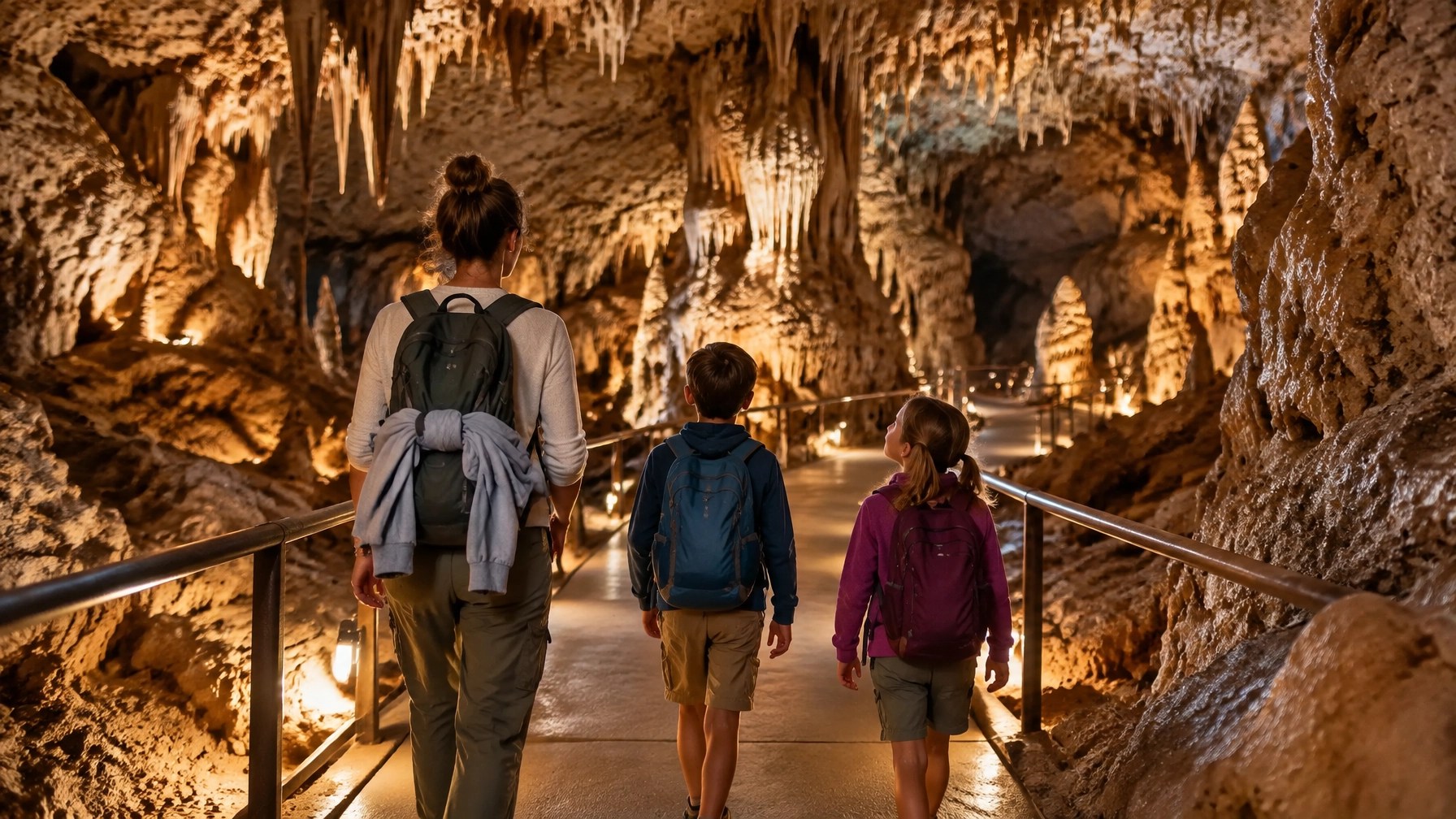
Florida Caverns State Park is home to the only dry caves in a Florida state park that are open for public tours. What families actually see is not a giant wild cave chamber but a guided route through a series of lower limestone rooms linked by paved walkways, handrails, lit formations and several stair sections. The park says visitors walk about 350 feet to the cave entrance, then descend about 35 steps into the cave, and some ceilings dip to about 4.5 feet. Inside, the rock is cream, gray and tan, with glossy flowstone, hanging stalactites, rising stalagmites and column formations that look almost sculpted. Kids usually notice the cooler air first, then the echo of voices, dripping water, and the way the lights catch the wet stone.
The walkway is paved, but this is still a cave tour with narrow passages, low ceilings and around 50 descents and ascents depending on conditions, so it is not stroller-friendly and not fully accessible. The official park pages also note that tours can be modified by water conditions. Above ground, the most useful family area is the Hickory day-use section, where the park lists a small playground near restrooms plus picnic pavilions and open green space.
Little kids who are comfortable with dark spaces usually spend the tour looking for shapes in the rock and listening for bats or cave crickets. Older kids tend to focus more on cave geology and the novelty of ducking through real rock passages. If your child dislikes enclosed spaces, the park visitor center has a cave-tour video and museum exhibits that can be a better backup plan.
- Drive time: About 1 hour from Tallahassee
- Cost: $5 per vehicle for park entry; cave tours are $16 for ages 13+, $9 for ages 3–12 and free for ages 2 and under
- Hours: Park, 8 a.m. to sunset; cave tours daily, 9 a.m. to 4 p.m. Central
- Best ages: About 4 and up for the cave tour; younger siblings may do better at the playground and picnic area
- Accessibility and gotchas: The cave stays around 65°F, so bring a light layer. Tickets are first come, first served at the gift shop unless limited online reservations are available, and tours often sell out on busy days. Low ceilings, stairs and narrow passages are part of the real experience.
See current Florida Caverns information before leaving.
2. Snorkel at Devil’s Den Prehistoric Spring
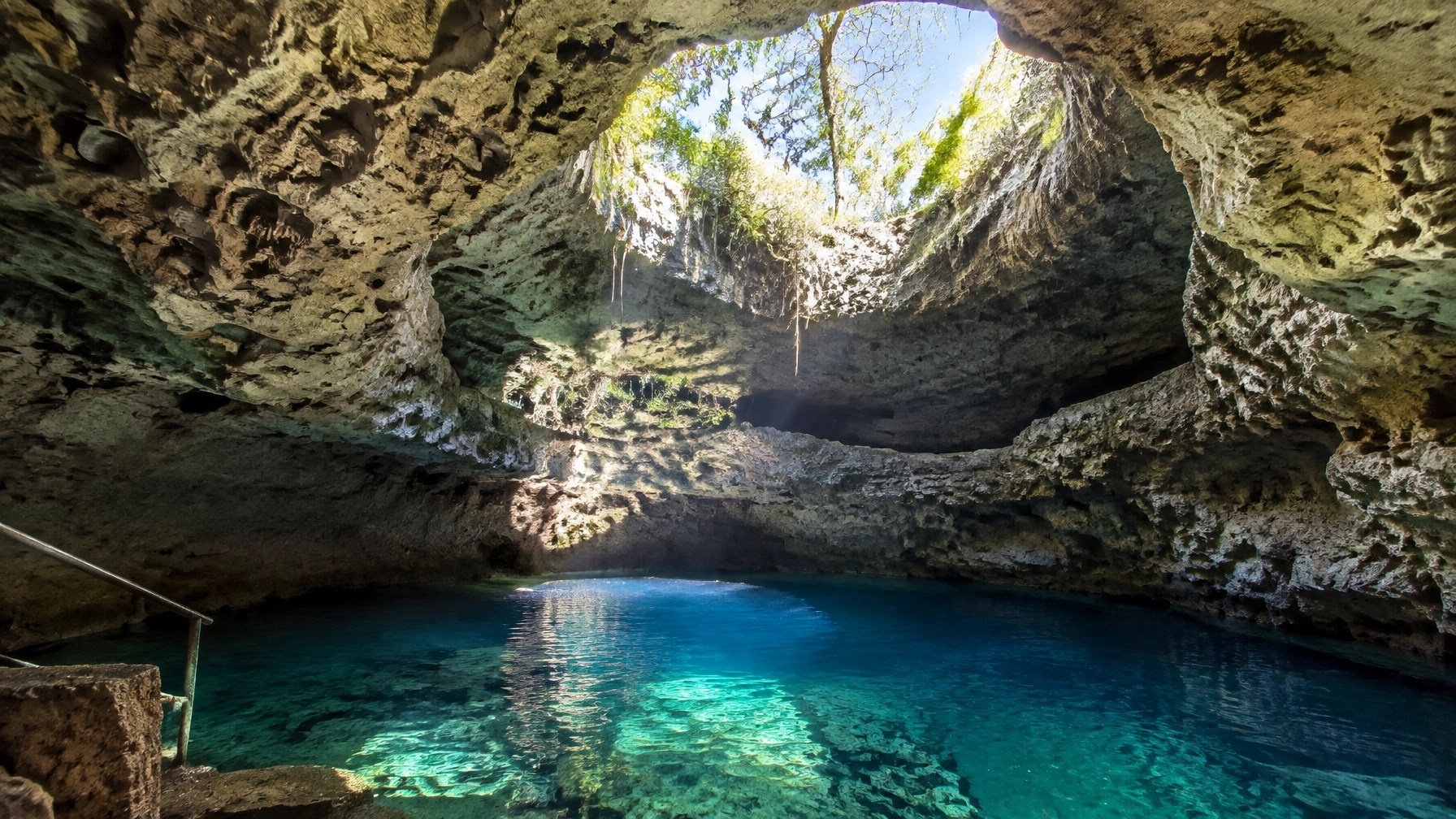
Devil’s Den is a collapsed-roof sinkhole near Williston where visitors descend into a prehistoric spring inside a dry cave. Visually, it feels more dramatic than a typical Florida swim stop: from above, you look down through an opening in the roof where daylight pours in like a spotlight, and below is a round basin of clear blue-green 72°F water ringed by ancient rock walls. The limestone walls show rough textures and fossil-bearing layers, and on cool mornings steam can rise through the opening, which is where the name comes from.
The descent matters here. Visitors reach the water by a stairway into the cave area, and the official site is clear that unescorted access to the stairs is not allowed for people who are not snorkeling or diving. Once in the water, this is not a splash pad or easy wading spring. Kids and adults float over deep, clear water with rock walls all around them, looking up at the circular opening overhead. The strongest sensory details are the cool air, damp stone, echoing voices, bubbles from divers, and the contrast between the dim cave interior and the bright shaft of sunlight from above.
Little kids under 6 are not allowed inside Devil’s Den. For kids 6 and up, this works best for strong swimmers who are comfortable with stairs, masks and enclosed spaces. Older children and teens usually get the most out of the snorkeling session because they can focus on the underwater visibility and cave atmosphere. Families with younger siblings should know the property also has other amenities such as changing areas, restrooms and picnic areas, but general swimming in the Den is not allowed.
- Drive time: About 30 minutes from Gainesville or 1½ hours from Orlando
- Cost: Snorkeling is $30 for a 90-minute session; equipment rental is extra; the official site also lists a $7 walk-through option on some pages, but current walk-through pricing and access language are inconsistent across the site, so verify directly before going
- Hours: Monday–Thursday, 9 a.m. to 4:30 p.m.; Friday–Sunday, 8 a.m. to 5 p.m.
- Best ages: Ages 6 and up for the cave; best for older kids, teens and confident swimmers
- Accessibility and gotchas: Reservations are required for snorkeling. Mask, snorkel and fins are required. Children under 6 are not permitted, flotation devices are generally not allowed, and the cave access involves stairs. This is a visually unforgettable stop, but it is not an easy option for nervous swimmers.
3. Ride a Glass-Bottom Boat at Silver Springs
Silver Springs State Park offers a classic Florida experience: a glass-bottom boat ride over exceptionally clear water. What families actually see from the boat is a broad spring basin and river system with shifting shades of aqua, emerald and dark green, sandy bottom patches, waving eelgrass, fish moving beneath the glass panels and occasional sunken movie props or statues depending on the route. The boats themselves are covered tour boats with central glass viewing panels, so kids usually cluster around the windows in the floor while adults look out at the banks.
Along the shoreline, expect thick Florida vegetation, cypress and other river-edge trees, and, sometimes, rhesus macaques in the trees along the river. They are real and well known at Silver Springs, but visitors should never feed or approach them. The overall feel is scenic rather than thrill-based: slow boat movement, tour narration, birds calling from the banks, and fish or turtles gliding beneath the boat. Families who add time on land will also find walking trails, paddling access and the Cracker Village/Pioneer Village area.
For younger children, the main draw is seeing straight through the boat floor and spotting fish. Older kids often get more interested in the history, wildlife and the strange sight of objects underwater. If you need accessibility, Silver Springs' operating site says the Chief Potackee boat is wheelchair accessible, but not every boat in the fleet is.
- Drive time: About 1½ hours from Orlando
- Cost: $8 per vehicle for park admission through the state park entrance; official glass-bottom boat pricing is currently $17 adults, $15 seniors and children ages 3–12 for the 30-minute tour, or $35 adults and $30 seniors/children for the 90-minute extended tour
- Hours: Park open daily, 8 a.m. to sunset; 30-minute glass-bottom tours generally run throughout the day, and extended tours have set departures, so confirm the current schedule before you drive over
- Best ages: All ages
- Accessibility and gotchas: Reserve ahead if this is your main reason for visiting. One wheelchair-accessible boat is listed, but not all boats are accessible. Arrival and boarding requirements may differ by boat.
4. Watch Manatees at Homosassa Springs Wildlife State Park
At Ellie Schiller Homosassa Springs Wildlife State Park, the star family feature is the Fish Bowl underwater observatory, where you descend into a floating observatory below water level and look out through big windows into the spring. The visual experience is very concrete: green-blue spring water, fish moving past the glass at eye level, and manatees drifting slowly through the frame like giant gray balloons with whiskered faces. The park’s Wildlife Walk uses elevated accessible boardwalks and paved areas to connect native-animal habitats, so families move through a shady, landscaped setting rather than a zoo with long bare sidewalks.
You will also see non-releasable Florida wildlife ambassadors including black bears, Florida panthers, bobcats, alligators, birds and Key deer. The sounds are part of the visit too: splashing at the spring, bird calls, kids tapping the observatory glass railings, and the deeper quiet along the boardwalk sections. Rain shelters are part of the Wildlife Walk, and the official park pages note accessible restrooms at the visitor center.
Preschoolers and early elementary kids usually do best here because the path is manageable and the animals are easy to spot without a huge amount of walking. Older kids often linger longer at the observatory and the manatee interpretation areas. The park currently notes that shuttle boat service is unavailable because of low water levels; the official site says a free tram is operating instead.
- Drive time: About 1½ hours from Tampa or Orlando
- Cost: $13 for ages 13+, $5 for ages 6–12 and free for ages 5 and under
- Hours: Daily, 9 a.m. to 5:30 p.m.; ticket counters close at 4:45 p.m.; Wildlife Walk closes at 5 p.m.
- Best ages: All ages, especially animal-loving preschoolers and elementary-age kids
- Accessibility and gotchas: The elevated Wildlife Walk is wheelchair- and stroller-friendly, and the main visitor area has accessible restrooms. Shuttle boat service is currently unavailable because of low water, so expect to use the free tram instead.
5. Tour the Quirky World of Solomon’s Castle
Solomon’s Castle in Ona looks exactly like the kind of place that makes kids ask, “What is that?” The three-story building glints in the sun because its exterior is covered in recycled aluminum printing plates, so from the road and parking area it reads as a tall silver folk-art castle rising out of rural Old Florida woods. Inside, families move through guided tour spaces filled with Howard Solomon’s handmade sculptures, stained glass and humorous mechanical-looking art pieces built from salvaged materials.
The setting is part of the experience. This is not a polished theme-park attraction; it is a quirky handmade environment in a quieter countryside setting. Kids tend to notice the drawbridge, the shiny metal exterior, the narrow stair-and-gallery feel inside, and the 60-foot replica Spanish galleon that houses the restaurant. The galleon and castle décor are colorful, theatrical and packed with odd details to point out. Because tours are guided and the humor is sometimes more adult or eccentric than kid-centered, most families with school-age children have an easier time here than families with toddlers.
The official website now lists current ticketing rather than a call-ahead-only price note. Admission to the grounds and parking are free, but tours are paid. The site also notes tickets are bought on-site, and some pages still say cash or checks only with an ATM on site, so that is worth confirming before you go.
- Drive time: About 1 hour from Sarasota or 1½ hours from Tampa
- Cost: The official ticket page currently lists the Traditional Castle Tour at $35 for ages 18–62, $32 for seniors/veterans, $14 for ages 13–17, $10 for ages 4–12 and free for ages 3 and under; combo and Encore tour pricing is also listed on the official site
- Hours: Tuesday–Sunday, 10 a.m. to 4 p.m.; summer hours may shorten Tuesday–Friday operations to 3 p.m.; closed Mondays and closed during August and September
- Best ages: School-age children and older
- Accessibility and gotchas: Because the castle is a multilevel handmade structure, families should expect stairs and older-building limitations. Payment policies on the official site are a little old-fashioned and may vary by page, so confirm current payment methods before making the drive.
6. Look for the Mystery at Coral Castle
Coral Castle in Homestead is an outdoor stone garden and sculpture site made from massive pale coral-rock blocks carved and arranged by Edward Leedskalnin. What families actually walk through is a compact but memorable landscape of gates, walls, carved tables, chairs, celestial symbols and huge upright stone pieces laid out like a handmade monument garden. The famous revolving gate is one of the details kids immediately want to test, and the scale of the stone is what usually lands best with children.
The textures and colors are simple but striking: chalky off-white to warm gray coral stone against South Florida sun, small planted areas, open sky and pathways between carved forms. The visit typically begins with a documentary and guided tour, then families move through the grounds while hearing the story of how one man supposedly moved and carved all of it himself. Younger kids often react more to the size and the shapes than the history. Older kids and teens usually get more interested in the mystery, engineering and astronomy references.
The official site says the museum is wheelchair accessible. One detail is less certain: different pages on the official Coral Castle site show slightly different closing information, so the published daytime opening is consistent, but evening cutoffs are worth rechecking the day you go.
- Drive time: About 45 minutes from Miami
- Cost: $25 adults; $10 ages 5–12; free ages 4 and under
- Hours: The official visit page lists daily hours of 9 a.m. to 8 p.m., with the last tour at 7 p.m. and gates closing at 7:30 p.m., but some other pages on the site show earlier evening times, so verify before heading down
- Best ages: Ages 5 and up
- Accessibility and gotchas: This is an outdoor stone attraction with sun exposure, so bring water and hats. The site says it is wheelchair accessible.
7. Make Your Car Roll Uphill at Spook Hill
Spook Hill in Lake Wales is one of Florida’s easiest, and strangest, stops. What you actually see is a regular paved city street with a painted stopping point and the well-known roadside sign telling drivers where to line up. There is no visitor center or built attraction around it. Families pull up, read the sign, shift into neutral and watch the car appear to roll uphill even though the effect is widely understood as a visual illusion or gravity-hill phenomenon.
The setting is a residential and roadside Lake Wales landscape rather than a scenic park, so this works best as a quick curiosity stop. Kids usually notice the surprise of the car moving “the wrong way” and the old local legend attached to the spot. Local tourism coverage still shares the story about a giant alligator and a Native chief, but what matters practically is that this is a very short stop measured in minutes, not hours.
Because you stay in the car for the main experience, it works for almost every age. Little kids enjoy the trick. Older kids usually want to repeat it and debate how it works. Shade, seating, picnic space and restrooms are not part of the attraction itself.
- Drive time: About 1 hour from Orlando
- Cost: Free
- Hours: Open-road roadside stop; visit in daylight
- Best ages: All ages
- Accessibility and gotchas: Stay in the vehicle area and follow the sign’s instructions. There are no official on-site restrooms or staffed facilities tied to the hill itself. It is best used as a quick add-on between larger stops.
8. Climb Around Pioneer Park in Port St. Lucie
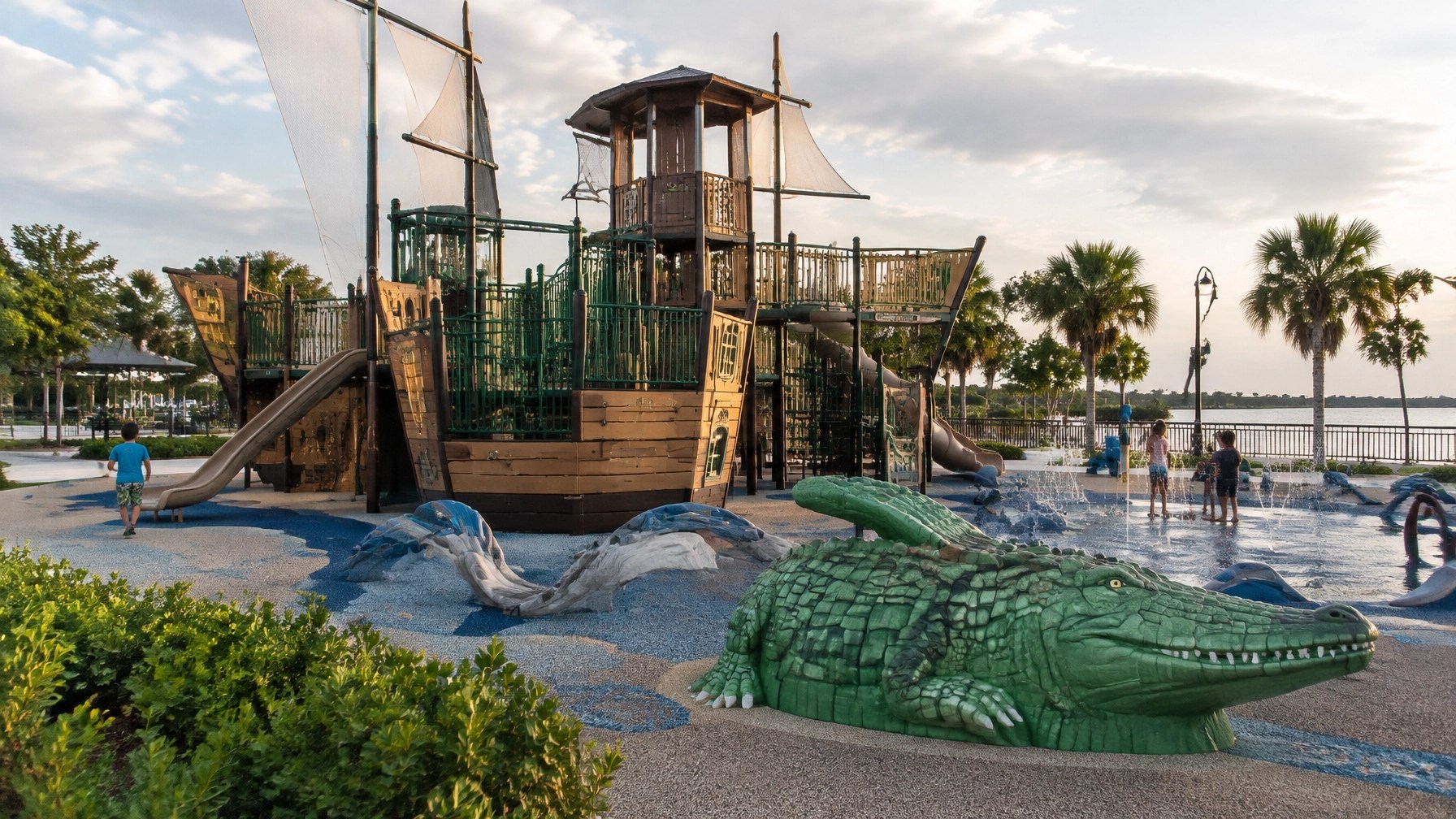
Pioneer Park in Port St. Lucie is much bigger and more developed than a typical neighborhood playground. The city describes it as a 9.75-acre riverfront park, and the play area is built around an imaginative Florida-waterways theme. Families will actually see a large river-boat play structure, an alligator-shaped element, an elevated water channel with sprays, a sand play area, swings, musical play features and an ADA carousel. The materials are modern playground plastics, metals and safety surfacing, but the design leans into natural greens, browns and water-inspired shapes rather than bright carnival styling.
The broader layout matters here. In addition to the playground, the park includes Banyan Basin, the city’s water-play area, a boardwalk along the North Fork of the St. Lucie River, a kayak/canoe launch, restrooms, parking, an event lawn, terraced seating and river views. There is also a big banyan tree area and lookout spaces, so this can feel more like a family outing spot than just a quick playground stop. Kids notice the sound of the splash features, the boats on the river, and the scale of the climbing structures.
Toddlers usually stay in the smaller play zones and water features. Older kids make more use of the larger climbers, swings and themed structures. Families needing breaks will appreciate that this is one of the more fully built-out playground destinations on the list, with restrooms and seating officially listed by the city.
- Drive time: About 1 hour from West Palm Beach
- Cost: Free
- Hours: The city currently lists playground hours of 9 a.m. to 9 p.m., and Banyan Basin splash pad hours of 9 a.m. to dusk
- Best ages: Toddlers through elementary age
- Accessibility and gotchas: Good pick for families who need varied play options, seating and restrooms. Shade exists in parts of the park, but sun exposure still matters, especially around the splash and open-play zones.
9. Play at Explorers Park at Babcock Ranch
Explorers Park at The PKWY in Babcock Ranch is a destination-level inclusive playground built as part of a connected linear park system through MidTown. The official Babcock Ranch descriptions emphasize custom all-abilities equipment, and the details families are most likely to notice are the life-size airboat, large alligator-themed play structure, sensory-focused spaces and the interactive 3-D Florida panther and cub simulation. The palette and theme are strongly Florida-wildlife based rather than generic primary-color playground design.
The surrounding setting is newer master-planned community landscaping rather than old-growth shade, with open walking connections to the other PKWY parks. Nearby Palmetto Park adds more family draw with a two-story treehouse-themed playground, splash features and a covered basketball court. That means older siblings can keep moving between zones while younger kids repeat the same sensory or climbing features.
Little kids usually gravitate to the sensory farm and lower play elements. Older elementary kids spend longer on the bigger themed structures and nearby companion parks. Official community materials clearly promote this as an inclusive, all-abilities destination, but public-facing sources do not give a detailed official park-hours page for every PKWY feature, so visit timing is one detail to double-check locally.
- Drive time: About 45 minutes from Fort Myers
- Cost: Free
- Hours: Community promotional pages describe the park but do not clearly publish a single official daily hours listing for all PKWY play areas, so check locally before going
- Best ages: Toddlers through elementary age
- Accessibility and gotchas: This is a strong choice for mixed-age and mixed-ability groups. Plan extra time if children want to visit both Explorers Park and Palmetto Park.
10. Find Tom Sawyer’s Play Island in Hialeah
Tom Sawyer’s Play Island at Amelia Earhart Park is a more detailed, adventure-style playground than the name might suggest. Miami-Dade describes it as an accessible play area for ages 2 to 12 with a fort-style tree house, climbers, spinners, slides, balance beams, swings and musical instruments. The overall feel is nature-inspired, with wood-look elements and climbing-focused equipment that encourages kids to move from platform to platform rather than simply going up and down one standard play tower.
The larger Amelia Earhart Park setting adds to the outing. This is a big county park with lakes and open parkland, so the playground sits within a broader recreational landscape rather than on its own. Some county materials also refer to Tom Sawyer’s Playground as a place with cave-like and adventure elements, though the exact current feature list beyond the official accessible equipment description is best taken from the main park page. The park has parking, and Miami-Dade’s official page notes a fee-based parking setup on busier days: free Monday through Thursday and paid Friday through Sunday and holidays.
Preschoolers can use the swings and smaller slides, but the playground’s appeal is strongest for children who like climbing, balancing and imaginative fort play. Families with very cautious toddlers may find it less relaxing than a flatter, fully toddler-centered playground. Restrooms and broader park facilities are part of the larger county park, not just the play island itself.
- Drive time: About 20 minutes from Miami
- Cost: Free playground access; parking is typically free Monday–Thursday and $8 Friday–Sunday and holidays
- Hours: Sunrise to sunset
- Best ages: Preschoolers through elementary-age children
- Accessibility and gotchas: The county lists the playground as accessible, but the climbing-heavy layout may still suit some children better than others. Wear closed-toe shoes and build in time to explore the wider park.
11. Cool Off at Fleischmann Park in Naples
Fleischmann Park is one of the most practical family playground stops on this list because it combines age-separated playgrounds with a splash zone and nearby restrooms. The city says the park has a toddler playground for ages 1 to 5 and a school-age playground for ages 6 to 12, both with sun shades, plus a water splash zone. Parents can expect modern equipment, softer surfacing, open sightlines and a sports-park setting rather than a nature preserve feel.
Around the playground area, the wider 15-acre park includes courts, ball fields, walking areas, a community center, water fountains and restrooms. That means families have benches, bathrooms and transition space for drying off or changing. Kids usually notice the change in pace here: active climbing, then immediate cooling off in the splash area, then snacks or a reset under the shade structures.
Toddlers do best in the separate younger-kid area and shallow spray play. Older kids bounce between the larger play equipment and water zone. One detail I could not confirm from the city’s main park page is a separately posted seasonal splash-pad calendar; the city clearly lists the splash zone as an amenity, but if splash operation is critical for your trip, it is smart to call ahead.
- Drive time: About 45 minutes from Fort Myers
- Cost: Free
- Hours: Outdoor park hours are 7 a.m. to 10 p.m.; community center hours differ, and specific splash-zone operating times are not clearly posted on the main park page
- Best ages: Toddlers through elementary age
- Accessibility and gotchas: The park has sun shades, restrooms and water fountains, making it easier than average with little kids. If you are coming mainly for water play, verify splash operation before you pack swimsuits and towels.
12. Follow the Story Stroll at Boundless Adventures
Boundless Adventures Playground in North Port combines all-accessible play equipment with a Story Stroll. Pages mounted along the path let families read a book while walking from station to station.
This is one spot where I could not verify enough 2026 detail from official city pages to safely add more specific layout, feature and amenities information without guessing. The playground and Story Stroll are locally referenced, but the exact current configuration, shade, restroom setup, parking details and age-specific feature list were not clearly confirmed on accessible official city pages during research.
- Drive time: About 30 minutes from Sarasota
- Cost: Free
- Hours: Check current park hours
- Best ages: Toddlers through early elementary
- Accessibility and gotchas: It is especially useful for families who want a quieter activity alongside active play, but confirm the current setup locally before you go if specific accessible features are important for your family.
13. Try Jacksonville’s Inclusive Playgrounds
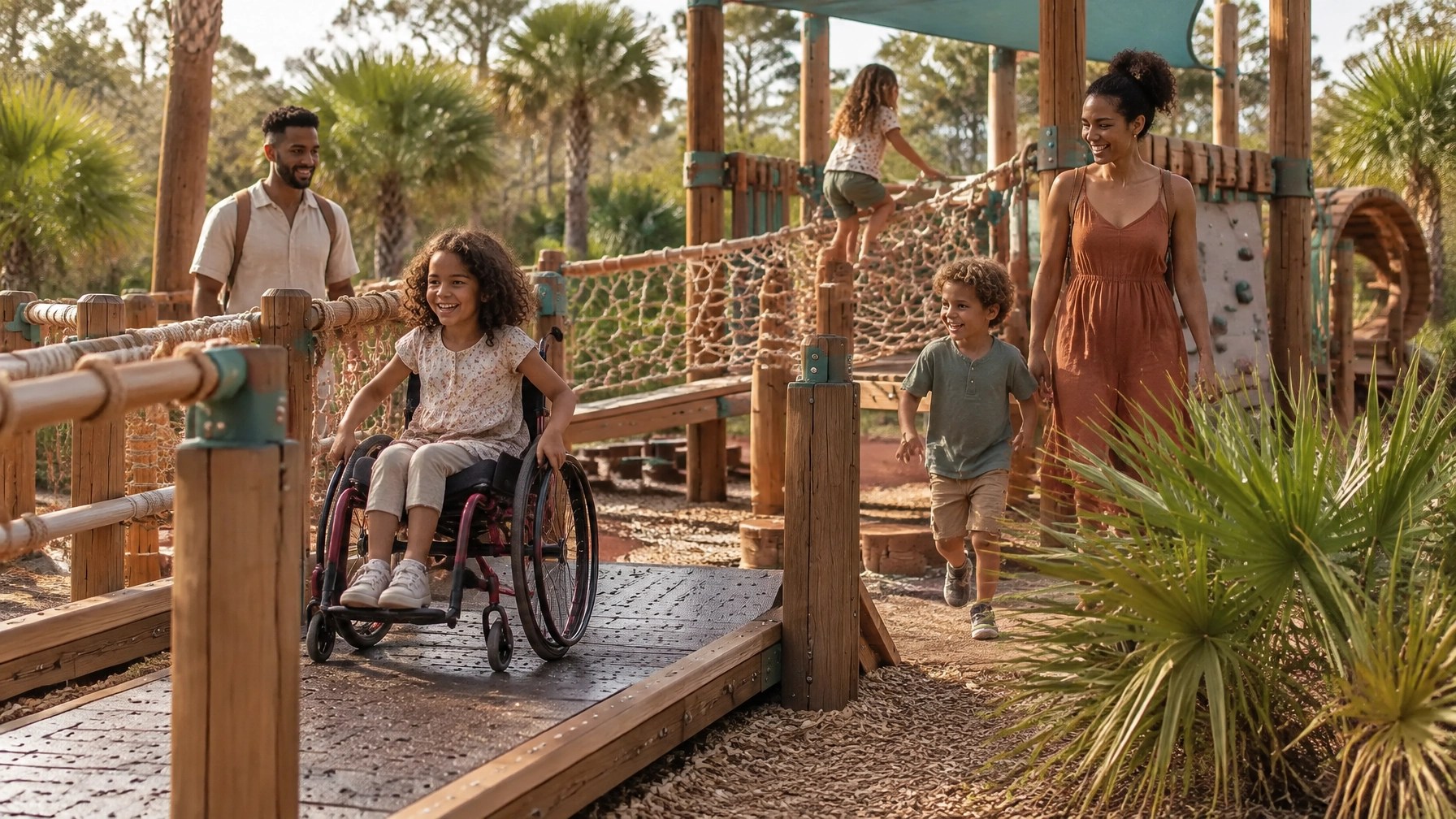
If your route follows I-95, Jacksonville offers two practical playground stops: Oceanway Community Center, Park and Pool, and Flossie Brunson Eastside Park. Both have official city-listed inclusive playgrounds, with Oceanway’s installed in summer 2024 and Flossie Brunson Eastside Park’s installed in spring 2023.
Oceanway is the more amenity-rich stop. The city lists an inclusive playground alongside restrooms, picnic areas, grills, benches, drinking fountains, parking and a wider park setting with sports space, a pool and even water access nearby. That makes it the easier break for families who need bathrooms and a proper reset during a long drive. Flossie Brunson Eastside Park is more of an urban neighborhood park stop with a newer all-inclusive playground and walking-path setting; it works well as a quick downtown-area break, but official city pages are lighter on detailed playground layout descriptions than at Oceanway.
For little kids, these are mostly stop-and-burn-energy playgrounds. Older kids can still enjoy them, but neither is framed by the city as a giant destination playground on the scale of Pioneer Park or Babcock Ranch. If detailed sensory equipment or exact feature lists matter to your family, Oceanway is the better-documented choice.
- Drive time: In Jacksonville; timing depends on your route
- Cost: Free
- Hours: Oceanway Community Center, Park and Pool is listed as open 6 a.m. to 6 p.m.; check current city hours for Flossie Brunson Eastside Park before going
- Best ages: Toddlers through elementary age
- Accessibility and gotchas: These are convenient stopovers rather than full-day destinations. Oceanway has the clearer official amenities list, including restrooms and picnic support.
14. Visit Epcot’s International Food & Wine Festival
The Epcot International Food & Wine Festival runs August 27 through November 21, 2026. It is the biggest event on this list, but it can fit an off-the-beaten-path itinerary if your family is already in Orlando and comfortable with theme parks.
What families actually walk through is a ring of temporary Global Marketplaces and festival kiosks layered through World Showcase and other EPCOT areas, with menu boards, queue stanchions, shaded tables in some spots, and the regular large-scale EPCOT setting around them. You still get the lagoon views, country pavilions and broad stroller-friendly pathways, but during the festival there is more booth traffic, more adults stopping to eat and drink, and more small lines scattered through the park. Disney’s official 2026 pages also confirm kid-friendly extras such as Remy’s Ratatouille Hide & Squeak and other seasonal activities, but the core vibe still leans toward tasting and browsing.
Little kids usually respond more to the scavenger-hunt-style activities and the built-in EPCOT attractions than to the food booths themselves. Older kids and teens may enjoy sharing small plates or trying festival snacks from different kiosks. Accessibility is generally strong because this is a major Disney park, but crowd levels and heat can make the day feel bigger than the map suggests.
- Drive time: Within the Orlando resort area
- Cost: Festival activities are included with valid Epcot admission; food and drinks cost extra
- Hours: During regular Epcot operating hours; check the current park calendar
- Best ages: Families already comfortable with theme parks
- Accessibility and gotchas: Set expectations: this is still more adult-leaning than child-centered. Festival crowds, stroller traffic and booth lines are part of the real experience. Compare attraction and resort discounts through Undercover Tourist.
15. Go to the Florida Seafood Festival in Apalachicola
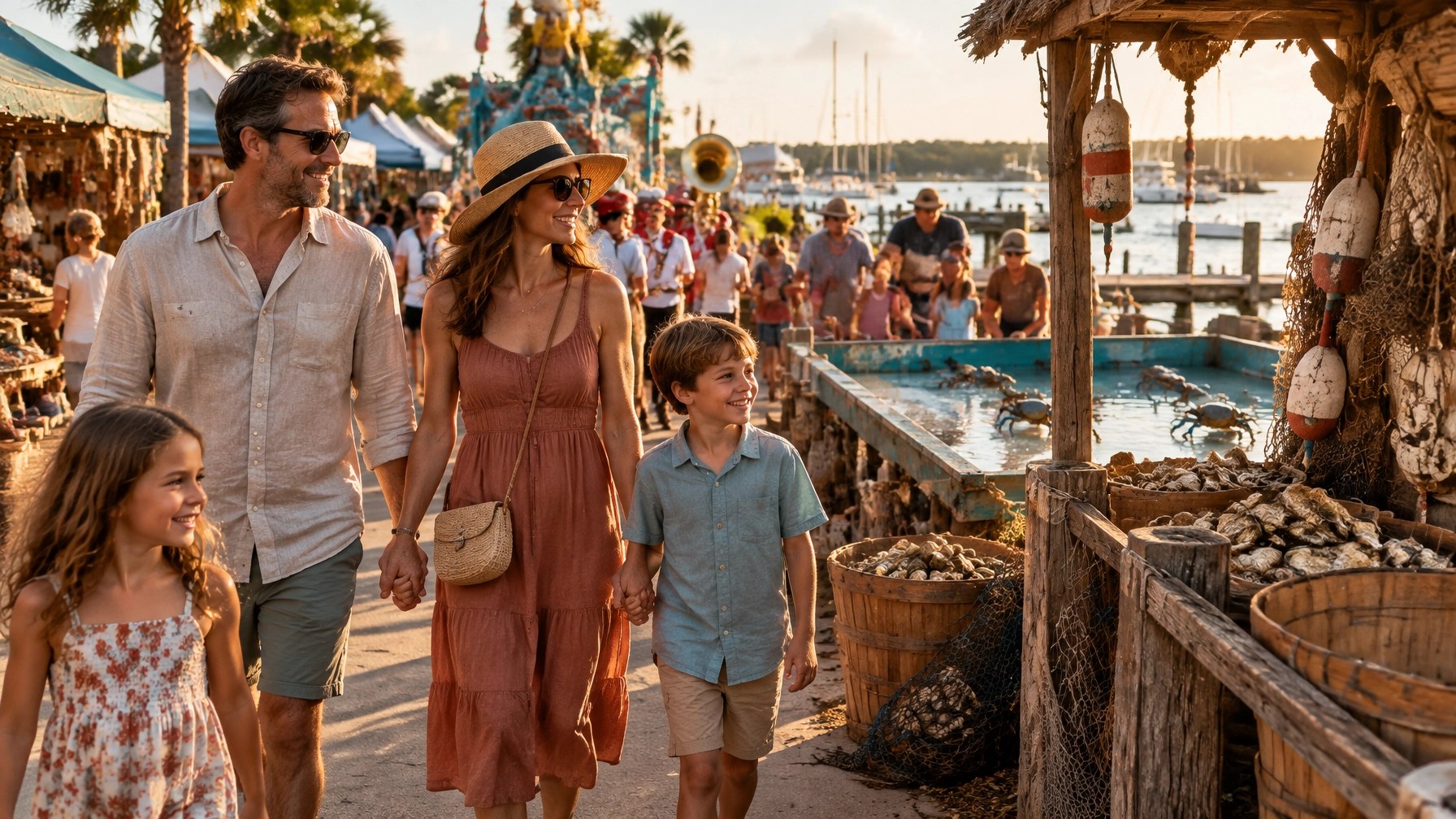
The 63rd Annual Florida Seafood Festival takes place November 6–7, 2026, at Battery Park in downtown Apalachicola. This is a true waterfront small-town event rather than a polished fairground production. Families walk into a bayside park setting with seafood tents, craft booths, live music, parade activity and fishing-town traditions that are much more local than theme-park-like. The visual backdrop is part of why it stands out: open water, working-boat culture, oak-shaded downtown streets nearby and Battery Park right on the edge of the river and bay setting.
According to the official schedule, Friday opens at 10 a.m. and Saturday includes the parade, Blue Crab Races, oyster shucking and oyster eating contests, music and other longstanding festival events. Little kids usually love the Blue Crab Races and parade atmosphere. Older kids may get more interested in the contests, boats and the feel of a real Gulf Coast community festival. Because the event spreads across park and downtown spaces, parents should expect some walking between attractions, vendor lines and variable shade depending on where you stop.
One useful 2026 detail the official festival schedule does confirm is admission: Friday is free, while Saturday gate admission is $10 and children under 12 are free. Parking and exact accessibility logistics can vary with annual event setup, so those are worth checking with organizers closer to the event.
- Drive time: About 1½ hours from Tallahassee or roughly 2½ hours from Panama City
- Cost: Friday admission is free; Saturday admission is $10; children under 12 are free
- Hours: Friday, November 6, park opens at 10 a.m. and closes at 10:30 p.m.; Saturday, November 7, gates open at 10 a.m. and the park closes at 10:30 p.m.
- Best ages: All ages
- Accessibility and gotchas: Crowds can be large, and seafood is the main attraction. Plan parking and child-friendly fallback food options early, and check the latest organizer guidance before you go.
Where to Stay for Florida Day Trips
A comfortable base makes these best places to travel with kids south much easier. Families visiting Orlando can pair a resort stay with day trips to Silver Springs, Spook Hill or Florida’s less-obvious attractions. For Orlando family vacation tips, compare resort locations, pool features, kitchen access and drive times, not just nightly rates.
You can compare family-friendly Florida resort and attraction discounts, including options near the major Orlando parks. Disney resort savings may also be useful if Epcot is part of your trip: Art of Animation, Coronado Springs and Animal Kingdom Lodge are three possibilities to compare.
For road trips, a rental car gives families more flexibility, especially for Marianna, Ona, Homestead and Apalachicola. A compact kids’ travel tray, motion-sickness roll-on and a small first-aid kit can also make long Florida drives easier.
Find more family travel planning ideas at Packed for Fun.
Confirm hours, prices, reservations and seasonal closures before driving out, since several of these attractions are weather-dependent, have changing schedules or close temporarily.